Sage 50 UK Source Connector
The Sage 50 UK source connector lets DataSync retrieve data from Sage 50 UK and load it into your data warehouse. Once your source connection is ready, configure your destination connection to finish the setup.
DataSync supports Sage 50 UK 2012 and later. For v28 (2022) and later, the SData adapter needs to be installed manually before following these instructions.
Step 1: Enable SData in Sage 50 UK
- Launch Sage 50 Accounts.
- Log in as Manager or another account that has elevated access.
- Expand the Tools tab and select Internet Options.
- Select the SData Settings tab and click Details next to Sage 50 Accounts.
- Copy the address of your company dataset. You will paste it into the connection properties in DataSync.
Step 2: Create the source connection in DataSync
- Log in to DataSync.
- From the welcome screen, select Connections.
- Next to Source Connections, click New.
- Select Sage 50 UK.
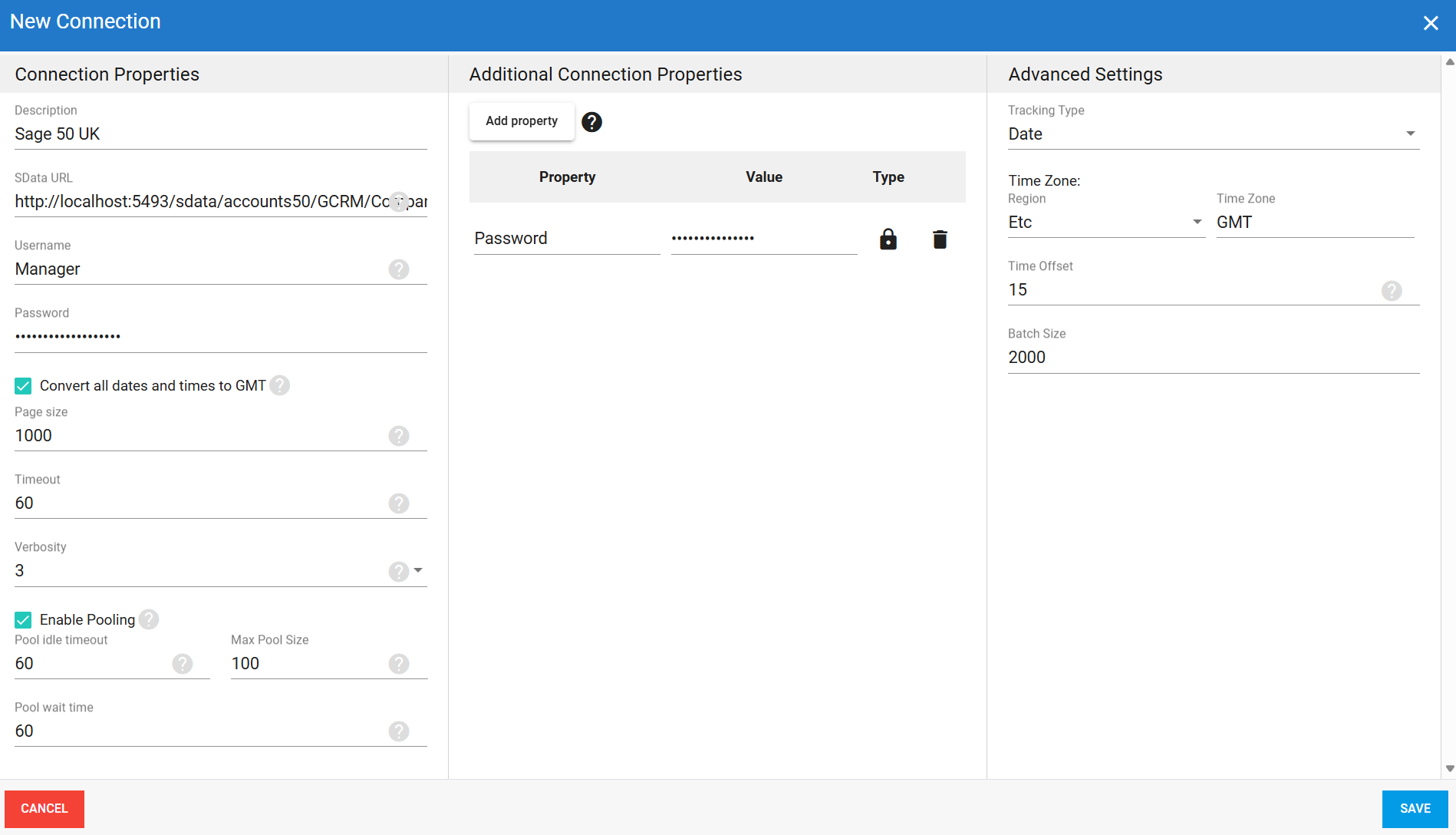
- Enter all required connection properties.
- (Optional) In the Additional Connection Properties panel, click Add property and enter any extra parameters you need.
- Configure the advanced settings to match your environment, including Tracking Type.
- Click Save.
Connection properties
| Property | What to enter |
|---|---|
| Description | Unique name for the connection. Example: Sage 50 UK. |
| SData URL | Address of the company dataset from the SData Settings in Sage 50 UK. Example:http://localhost:5493/sdata/accounts50/GCRM/CompanyName/ |
| Username | Login account with Manager access or equivalent elevated permissions. |
| Password | Password for this account. |
| Convert all dates and times to GMT | Converts all DateTime values to GMT. Recommended when your Sage 50 UK environment runs in a different time zone and you need consistent timestamps across your data. |
| Page Size | Maximum number of results returned per page. Larger values return more rows per page but may increase timeout risk. |
| Timeout | Time in seconds to wait before a connection attempt or query execution times out. |
| Verbosity | Controls how much detail the connector writes to the log. Each level includes everything from the level below it, plus additional detail.
|
| Enable Pooling | Enables connection pooling, which keeps a set of database connections open and reuses them across extractions instead of opening a new connection each time. This reduces overhead and improves performance when multiple extractions run at the same time. |
| Pool idle timeout | Time in seconds a connection can stay idle before returning to the pool. |
| Max Pool Size | Maximum number of connections allowed in the pool at the same time. |
| Pool wait time | Time in seconds DataSync waits for an available connection before throwing an error. |
Additional connection properties
Use this panel to enter connection string properties not available in the Connection Properties panel. For sensitive values such as passwords, set the type to Encrypted. The value is hidden in the interface and stored encrypted in the back end.
| Property | What to enter |
|---|---|
| Property | Connection string property that defines the action or behavior. Example: ReadOnly |
| Value | Value for the property. Example: True |
| Type | Visibility settings: Visible or Encrypted. |
Advanced settings
These settings control how the connector tracks data changes, handles time and regional configuration, and processes records during extraction. Configure them to match your Sage 50 UK environment so that results stay accurate and consistent.
| Setting | What to select |
|---|---|
| Tracking Type | Method for tracking data changes: None or Date. |
| Region | Region setting for the connector, if required by your setup. |
| Time Zone | Time zone matching your Sage 50 UK environment. |
| Time Offset | Refresh offset in seconds to compensate for timing issues in record selection. Minimum 0, maximum 3600. |
| Batch Size | Number of records processed per batch during extraction. Larger batches can improve performance but use more memory. Default is 2000, maximum is 10000. Adjust based on your network speed and disk performance. The default works well in most cases. |
Example setup