Flat File Source Connector
The Flat File source connector lets DataSync retrieve data from structured text files such as CSV and TXT and load it into your data warehouse. For large files, you can adjust row scanning or override automatic detection using a custom Schema.ini file. You can also connect to local, network, or cloud‑hosted CSV resources by setting the URL parameter and any required authentication properties.
Once your source connection is ready, configure your destination connection to finish the setup.
Create the source connection in DataSync
- Log in to DataSync.
- From the welcome screen, select Connections.
- Next to Source Connections, click New.
- Select Flat File.
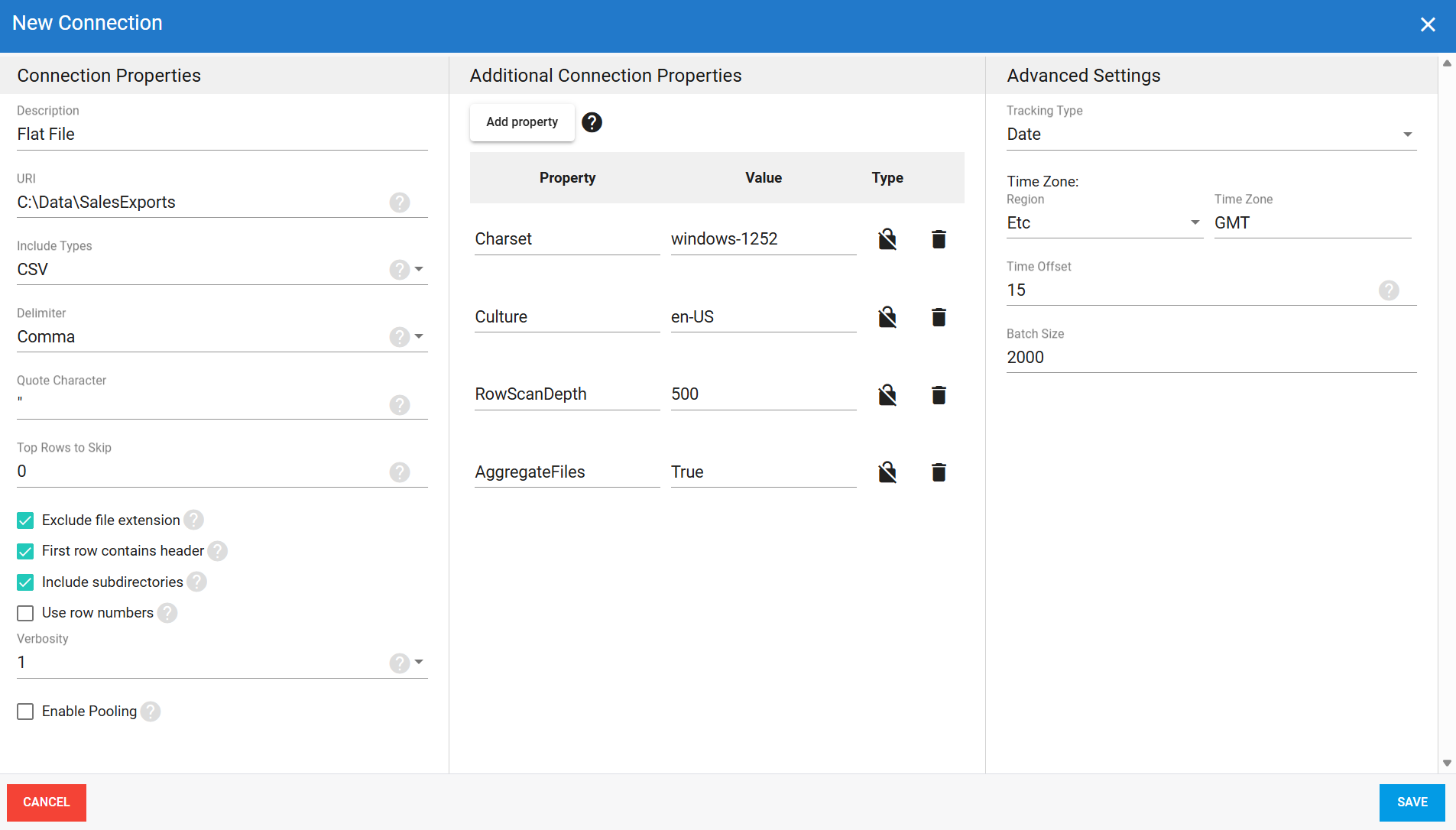
- Enter all required connection properties.
- (Optional) In the Additional Connection Properties panel, click Add property and enter any extra parameters you need.
- Configure the advanced settings to match your environment, including Tracking Type.
- Click Save.
Connection properties
| Property | What to enter |
|---|---|
| Description | Unique name for the connection. Example: Flat File. |
| URL | Path to the source file or folder. Supports local paths, network shares, and can point to a single CSV file or a folder containing multiple files. Example: C:\Data\SalesData.csv or \\Server\Share\Data. |
| Include Types | File types to include: CSV, TXT, or both. |
| Delimiter | Character used to separate values: Comma, Tab, or Custom. |
| Custom Delimiter | Character used when Delimiter is set to Custom. Example: ;. |
| Quote Character | Character used to wrap quoted values in the file. |
| Top Rows to Skip | Number of rows to skip at the top of the file before reading data. |
| Exclude file extension | Removes the file extension from table names during extraction. |
| First row contains header | Treats the first row as column headers. |
| Include subdirectories | Includes files and schema.ini from nested subfolders. |
| Use row numbers | Adds a RowNumber column as a key when updating or deleting CSV records. |
| Verbosity | Controls how much detail the connector writes to the log. Each level includes everything from the level below it, plus additional detail.
|
| Enable Pooling | Enables connection pooling, which keeps a set of database connections open and reuses them across extractions instead of opening a new connection each time. This reduces overhead and improves performance when multiple extractions run at the same time. |
| Pool idle timeout | Time in seconds a connection can stay idle before returning to the pool. |
| Max Pool Size | Maximum number of connections allowed in the pool at the same time. |
| Pool wait time | Time in seconds DataSync waits for an available connection before throwing an error. |
Additional connection properties
Use this panel to enter connection string properties not available in the Connection Properties panel. For sensitive values such as passwords, set the type to Encrypted. The value is hidden in the interface and stored encrypted in the back end.
| Property | What to enter |
|---|---|
Charset | Character encoding for the source file when it uses ANSI encoding. Not needed for UTF-8 files. Example: windows-1252. |
Culture | Regional format that determines how decimal and thousands separators are interpreted. Must match between source files and your DataSync configuration. Example: fr-FR for comma decimals or en-US for period decimals. |
RowScanDepth | Number of rows scanned to infer column data types. Default: 100. Use 5000 for better accuracy on varied data, or 0 to scan the entire file. |
AggregateFiles | Combines all files from the source folder into a single table called AggregatedFiles. The schema is taken from the first file unless MetadataDiscoveryURI is set. Useful when working with multiple files that share the same structure, such as monthly export files. |
IncludeFiles | Comma-separated list of file extensions to include. Default: CSV,TXT,TAB. Supports files without extensions (NOEXT), archives (ZIP, TAR, GZ), file masks, and date filters. Example: IncludeFiles=2020*.csv,TXT. |
ExcludeFiles | Comma-separated list of file extensions to exclude. Supports the same date and mask filters as IncludeFiles. Example: ExcludeFiles=TXT. |
InsertMode | Controls how data is written to CSV files.
|
CreateBatchFolder | Creates a folder when InsertMode is set to FilePerBatch. Default: true. |
BatchNamingConvention | Naming format for batch files.
|
Advanced settings
These settings control how the connector tracks data changes, handles time and regional configuration, and processes records during extraction. Configure them to match your Flat File environment so that results stay accurate and consistent.
| Setting | What to select |
|---|---|
| Tracking Type | Method for tracking data changes: None or Date. |
| Region | Region setting for the connector, if required by your setup. |
| Time Zone | Time zone matching your Flat File environment. |
| Time Offset | Refresh offset in seconds to compensate for timing issues in record selection. Minimum 0, maximum 3600. |
| Batch Size | Number of records processed per batch during extraction. Larger batches can improve performance but use more memory. Default is 2000, maximum is 10000. Adjust based on your network speed and disk performance. The default works well in most cases. |
Example setup